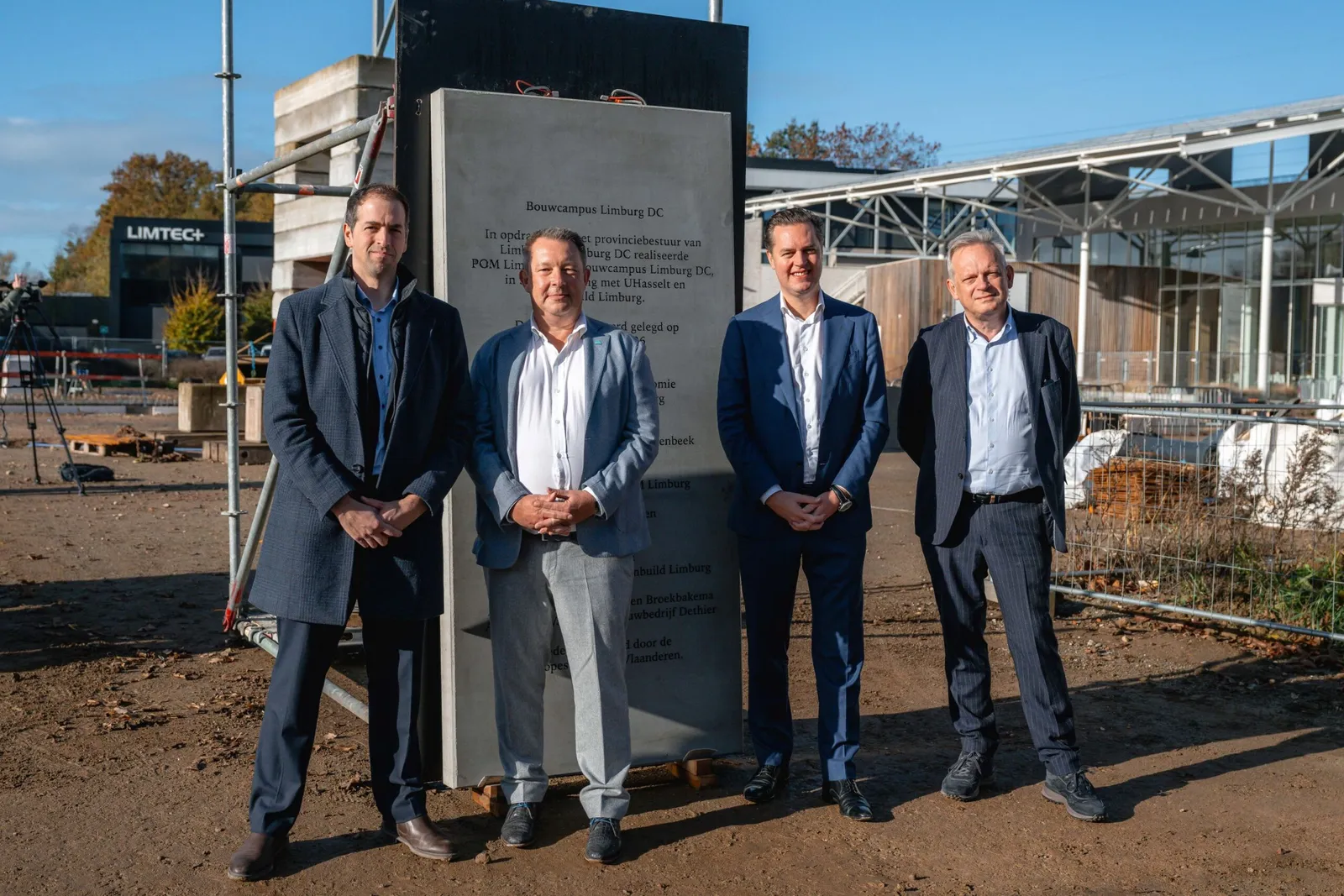
At the Limburg DC campus in Diepenbeek, the symbolic first stone was laid today for the Construction Campus. This new knowledge center for the construction sector will feature an innovative climate system, a Belgian first, and advances circular construction with, among other things, a reusable wooden support structure. POM Limburg is leading the project, which involves an investment of 27.2 million euros. The opening is scheduled for spring 2028.
Bouwcampus Limburg DC is a joint project by the province of Limburg, POM Limburg, UHasselt, and Embuild Limburg. The building will bring together companies, researchers, and construction professionals to exchange knowledge and to develop and test new construction techniques and circular building materials. Construction began in April.
The building will be the first in Belgium to feature the so-called Earth, Wind & Fire system. This system uses natural forces for ventilation and cooling, reducing energy consumption and improving indoor climate. It is also the first time this technology is applied in a building with a cross-laminated timber (CLT) structural frame. With solar panels integrated into the facade and canopies, the Construction Campus aims to generate more energy annually than it consumes. Rainwater will be collected, and wastewater from sinks will be purified via a reed bed.
Tom Vandeput, deputy for Economy and chairman of POM Limburg, emphasized the campus's importance: “The construction sector faces an enormous challenge to build more sustainably and smartly. With the Construction Campus, we are demonstrating that this transition is already possible today. We are investing not only in a new building but also in a place where knowledge and innovation converge, and where Limburg construction companies can discover and apply the techniques of tomorrow.”
The design focuses on reuse, featuring a wooden support structure that can be dismantled for future adaptation or expansion. The intended lifespan is at least 100 years. At least 55 percent of the materials in the shell and technical installations must be bio-based, reused, or recycled, increasing to 70 percent for the finishing. Even the existing parking lot will get a second life, with removed paving stones reused in landscaping and the ground floor. The concrete also contains extra recycled aggregates.
The design is by the Dutch firm Broekbakema and Hasselt-based a2o architecten. The execution is handled by Vanhout from Geel and Dethier from Alken. Through the digital platform Bimefy, the construction progress is linked to a three-dimensional building model.
Bert Lenaerts, managing director of Vanhout, described the project as an innovation in itself: “With this building, almost every step in its realization is an innovation. It is exceptional that so many different innovations come together in one building, with such a consistent focus on circularity. This makes execution more complex and challenging than with other special projects we have undertaken. The strength of Vanhout and Dethier lies precisely in this complexity: together with the entire construction team, we seek solutions and make it truly feasible.”
The Construction Campus will house offices for, among others, Embuild Limburg, Inter, and DUBO, flexible workspaces, multipurpose meeting rooms, and an auditorium. UHasselt is expanding its building application center with a 1,100 m² laboratory, where researchers and companies can develop and rapidly test new circular construction solutions.
Bernard Vanheusden, rector of UHasselt, sees the campus as a bridge between practice and research: “The Construction Campus literally bridges the gap between construction practice and broad construction research at UHasselt. The new building will house exceptional infrastructure for top European research. At the same time, it will be a unique place where engineers, architects, environmental economists, IT specialists, and other researchers can work interdisciplinarily with the construction sector.”
Chris Slaets, managing director of Embuild Limburg, added: “Circular, modular, multifunctional, and digital construction are gaining ground. The innovative design of the new Construction Campus demonstrates how these developments can take shape in practice. Furthermore, the research infrastructure offers many possibilities to further develop new construction techniques and accelerate their application in the sector. Thus, the Construction Campus can make a significant contribution to the future of the Limburg construction industry.”
POM Limburg is responsible for the development and realization of the construction project, with support from the province of Limburg and European ERDF funds. The total investment amounts to 27.2 million euros, supplemented by private financing. The opening is scheduled for spring 2028. The project has a total budget of 27.2 million euros, co-financed by ERDF (9.4 million euros) and Flanders (3.5 million euros).