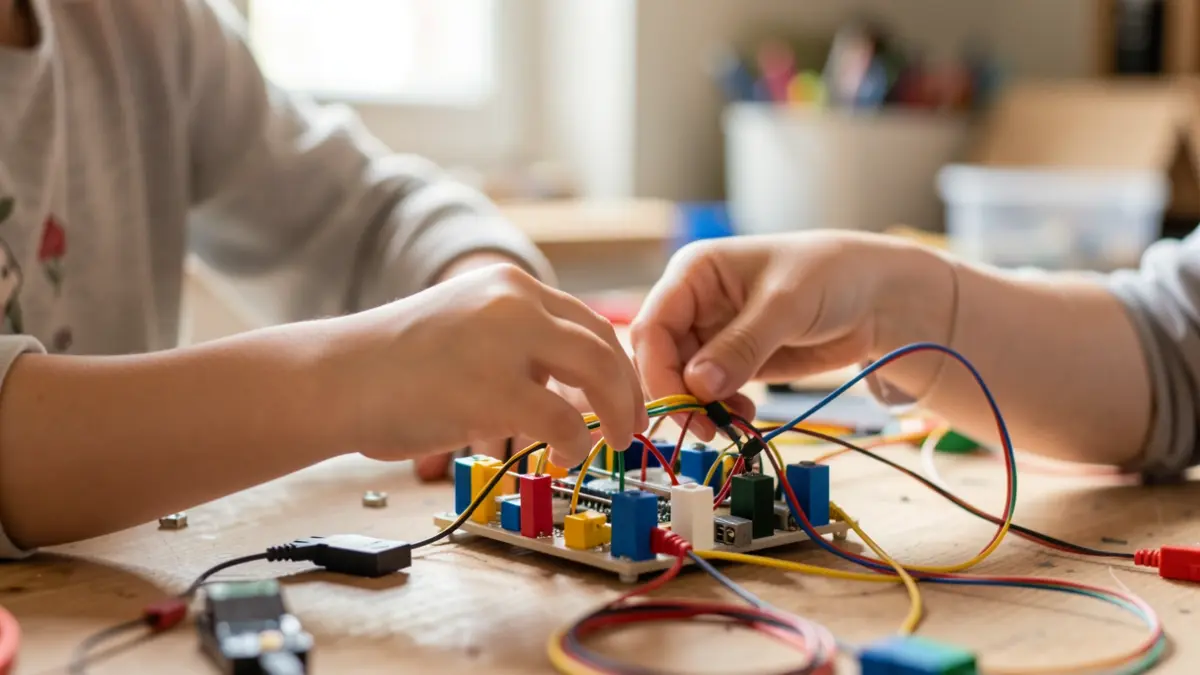
Within the European project TINKERVERSE, running until 2027, Howest and eight international partners are developing new learning pathways for children and young people aged between 3 and 15. The project focuses on stimulating creativity, digital skills, problem-solving, and collaboration through 'making'.
Howest is pooling the expertise of its Mind-and Makerspace and teacher training programs for this purpose. In the Mind-and Makerspace, young people learn by experimenting, designing, and making, while the teacher training programs ensure the pedagogical and didactic development of these activities. Through STEAMhive, Howest's network for STEAM education, knowledge is shared with organizations that introduce children and young people to science, technology, art, and creativity outside the school context.
Katrijn Bulckens, researcher at Mind-and Makerspace and project manager for TINKERVERSE, emphasizes: “We don't just want to offer more STEAM, but primarily to better understand what quality STEAM education is. This way, we can develop activities through which children and young people learn meaningfully by experimenting, designing, and collaborating.”
In the spring of 2027, the developed approaches will be tested with participating classes at the Mind-and Makerspace in Bruges. Students will work on a STEAM challenge during several sessions. Teachers will also be involved in the preparation and evaluation, and a separate test workshop is planned for special education schools. Experiences from this pilot phase will be used to further refine the activities.
In addition to the learning pathways, TINKERVERSE is also developing a 'train-the-trainer' offering for education professionals and facilitators. The three-year European Erasmus+ project is coordinated by the University of Burgos.