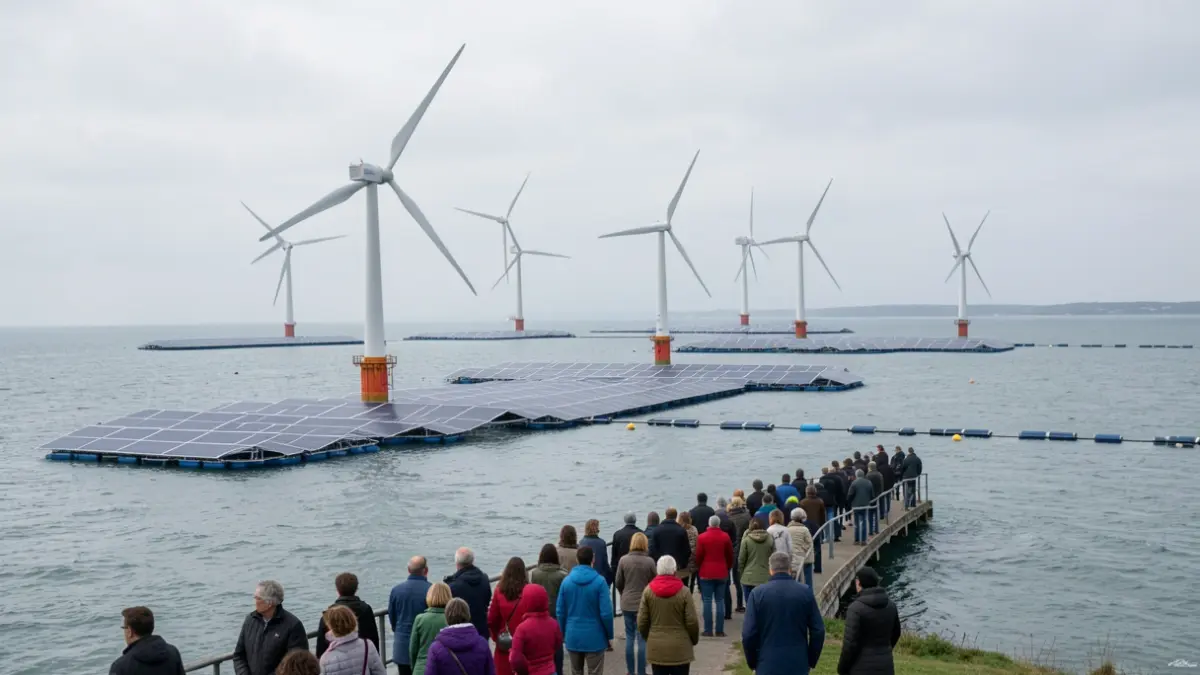
Belgium has built a strong position in offshore wind energy over the past two decades. As more renewable energy is produced at sea, the question is no longer just how much energy we can generate offshore, but also how to utilize marine space and offshore infrastructure more efficiently. The SWiM project brought together six partners from industry and science to investigate how Offshore Floating Photovoltaics (OFPV), or floating solar panels at sea, can be integrated into offshore wind farms in the Belgian North Sea in a technically feasible, ecologically sustainable, and spatially efficient manner. SWiM examined how offshore wind and solar energy can be combined within the same area, allowing both energy sources to complement each other and optimize the use of available space and infrastructure at sea.
Within work package 5, coordinated by De Blauwe Cluster, SeaVolt investigated how much floating solar energy can be integrated into the existing eastern zone and the future Prinses Elisabethzone. This included examining the available space between wind turbines and the capacity of the offshore electrical infrastructure. The study focused exclusively on what is technically possible; costs and economic feasibility were not considered.
In the baseline scenario, up to 1.5 MW of floating solar energy can technically be integrated per 1 MW of offshore wind energy. This would result in approximately 6% loss of potential solar production due to curtailment at certain times. Depending on the safety distance between solar panels and wind turbines, there is space for 3.2 to 8.2 GW of offshore solar panels within the Belgian offshore concessions.
With a distance of 300 meters from wind turbines, floating solar panels could annually produce approximately 7.4 TWh of additional renewable electricity. In the existing eastern zone alone, this could increase annual renewable electricity production by about 45% compared to offshore wind production in 2025. In another scenario, assuming larger future wind turbines and 2 MW of solar energy per MW of wind energy, approximately 11 GW of offshore solar capacity could be installed, yielding an annual electricity production of nearly 9 TWh.
A striking conclusion is that the capacity of the electricity grid, rather than the available sea space, is likely to be the biggest limitation for large-scale rollout. Within the Belgian offshore wind concessions, there appears to be significant physical potential for floating solar energy. The challenge lies in integrating this additional production into the offshore electrical infrastructure. By combining wind and solar energy, existing and future offshore infrastructure can be utilized much more intensively.
The importance of the SWiM results extends beyond floating solar energy alone. SWiM demonstrates how offshore wind zones can gradually evolve into multi-use zones, where different activities share marine space, infrastructure, and services. The combination of offshore wind and floating solar energy can be one of the first concrete steps in this direction. Once different forms of renewable energy can successfully coexist within the same offshore area, it will be possible to explore how other compatible activities can be integrated. This leads to the concept of Mariparks, integrated offshore areas where renewable energy production forms the backbone for various compatible activities within the blue economy, such as environmental monitoring, biodiversity enhancement, and aquaculture.
The SWiM results provide a concrete vision of what such multi-use could look like. However, demonstrating technical potential is only the first step. Pilot and demonstration projects are needed to further reduce the risks of floating solar energy at sea and test its integration under real conditions. Safe electrical integration, anchoring solutions, appropriate regulations, and contractual agreements will also need to evolve in line with the technology. For Belgium, already a pioneer in offshore wind energy, SWiM points to a potential next evolution: from offshore wind farms to wind + solar, then to broader multi-use, and finally to integrated Mariparks.